 Camber Gauge
Camber vs Toe Tire Wear: Why the Inside Edge Wears Out
Inside tire wear can involve camber, toe, or both. Learn the difference, what tread patterns reveal, and what a phone camber reading can actually tell you.
Quick answer: Excessive negative camber can concentrate wear on the inside shoulder. Incorrect toe makes the tire scrub as it rolls and can leave feathered tread edges. Both can be present on the same wheel. An inside edge wearing out is a reason to check the alignment and suspension, not enough evidence to blame camber alone.
You notice the wheel leaning inward. Then you find the worn strip on the inside of the tire. The explanation seems obvious: the lean did it.
It might have contributed. But that visible tilt tells you nothing about whether the wheel also points slightly inward or outward when viewed from above. A tire can have an acceptable camber reading and still wear badly because its toe is wrong.
The useful question is what each angle is doing, and what you need to measure before deciding on a fix.
Camber tilts the tire; toe changes where it points
Look at a wheel from directly in front of the car. If its top leans toward the car, that is negative camber. If the top leans away, it is positive camber.
Now imagine looking straight down at the car. Wheels pointing toward each other have toe-in; wheels pointing away have toe-out. A wheel can stand upright and still have incorrect toe.
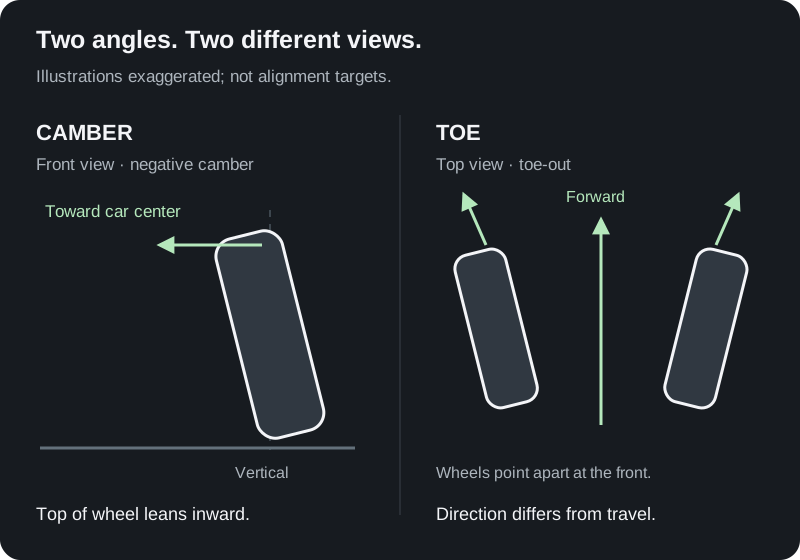
Angles are exaggerated to show the difference. Camber and toe are measured from different views.
Tire Rack’s alignment guide describes the tradeoff: negative camber helps maintain useful tire contact during cornering, but too much for the vehicle and its use can favor inner-edge wear during straight driving. Toe error adds sideways scrub as the tire rolls. Neither angle should be judged without the vehicle’s specification.
What camber wear and toe wear can look like
The distinction is easiest to understand at two scales: across the whole tire, and across an individual tread rib.
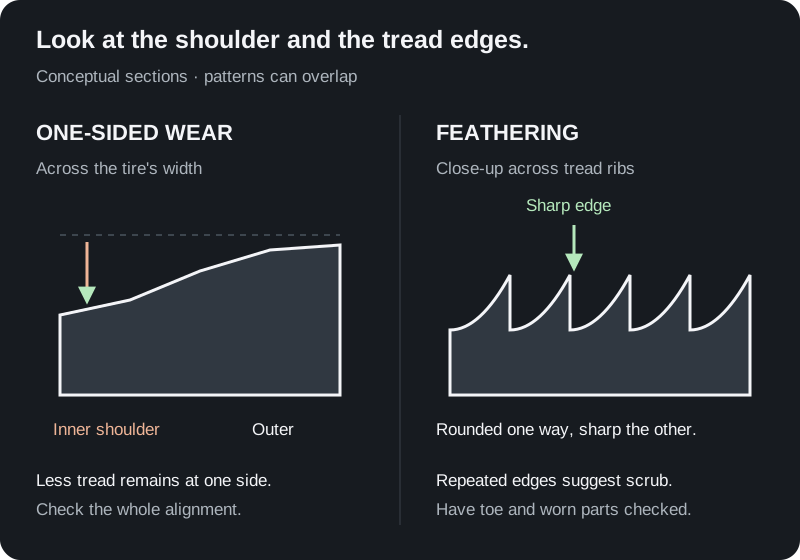
These are simplified illustrations, not diagnostic photographs. Real tires can show overlapping patterns.
| What you notice | What it can suggest | What needs checking |
|---|---|---|
| Inner shoulder is shallower than the rest | Alignment-related one-sided wear; negative camber may contribute | Camber, toe, suspension condition and vehicle setup |
| Repeated sharp and rounded edges across tread ribs | Feathering associated with sideways scrub | Toe and steering or suspension wear |
| Both shoulders wear more than the center | A possible history of underinflation | Cold pressure against the vehicle placard, plus tire inspection |
| Center wears faster than the shoulders | A possible pressure or use-related issue | Pressure, load and driving conditions |
| Scalloped or patchy low spots around the tire | Possible balance or suspension problems | Tire, wheel and suspension inspection |
Michelin’s wear guide distinguishes these patterns. Its feathering guide specifically connects sawtooth edges with scrubbing and a likely need for toe correction. Treat those clues as a way to describe the problem to a technician, rather than a diagnosis from a photograph.
Does negative camber always wear tires?
No. A negative number alone does not tell you that the alignment is wrong. The amount, the vehicle’s specification, toe, tire construction, load and driving all matter. There is no universal angle below which tire wear is guaranteed to be even.
Consider two hypothetical cars that both measure −1.5° on a rear wheel. One is within its specified range with correct toe. The other has an out-of-spec toe reading and a worn suspension bushing. The matching camber numbers do not make their setups equivalent, and they cannot predict matching tire life.
That is why “my car runs the same camber and its tires are fine” is weak evidence. You need the other measurements and the relevant specifications before the comparison means much.
For a sense of how small these angles look, our camber degrees to millimeters guide translates the tilt into a distance you can picture.
Why a lowered car needs more than a camber check
Changing ride height can change the wheel alignment. The visible camber change is only part of the picture.
Continental explains that modified suspension geometry can also behave differently while driving, even when static readings appear within tolerance. A lowered car with inner-edge wear needs an assessment of its actual setup, including toe and suspension condition.
If the wear started after lowering the car, changing suspension parts or hitting a curb, tell the alignment shop. That history is more useful than asking it to remove a particular amount of negative camber without checking anything else.
What a phone camber reading can establish
A phone held against a suitable wheel reference can estimate tilt relative to gravity. That gives you a camber check, provided the floor, calibration and placement are controlled. Our phone camber measurement guide covers those setup errors.
Camber Gauge lets you record the four wheels, enter your own targets and keep measurement history for each vehicle. A saved session is useful when comparing repeated checks under the same conditions.
It does not measure toe. A green camber comparison in an app cannot clear the rest of the alignment, identify a worn bushing or establish that a tire is safe to keep using.
For example, if you record similar camber readings on both rear wheels but one tire is wearing much faster, you have a useful observation to bring to the shop. You still need to find out why. Do not assume the answer is to make that wheel more upright.
What to do when you find inside tire wear
- Have the tire’s condition assessed. The inner shoulder can be difficult to see. If cords are exposed, the tire needs replacement; an alignment cannot make it usable again. Michelin’s guidance explicitly addresses exposed cords.
- Record which tire and where it is worn. Keep photos and any tread-depth measurements labeled by wheel position. “Left rear, inner shoulder” is a better starting point than “the alignment is bad.”
- Check cold pressures against the vehicle placard. Record what you find before changing anything. Pressure is one part of the investigation, not proof of the cause.
- Request an alignment and suspension check. Ask for the before-and-after printout, including individual toe and camber for each measured wheel. Mention modifications, impacts and recent repairs.
- Keep a baseline after the repair. Save the printout, tire condition and date so the next inspection has something concrete to compare against.
Correcting the cause does not put worn rubber back. The aim is to protect the replacement tire, or the remaining usable tread, from repeating the same pattern.
Questions that come up often
Can toe cause inside tire wear even if camber is within spec?
Yes. An acceptable camber reading does not rule out toe-related scrub. Check both angles and the mechanical condition rather than treating an in-range camber number as a complete alignment result.
Will setting camber to zero fix it?
There is no universal zero-camber fix. Use the specification for the vehicle and its setup. Changing camber alone leaves an existing toe or suspension problem unresolved.
Can rotating the tires fix the cause?
Rotation changes tire position; it does not correct alignment or repair worn components. Follow the applicable rotation instructions, and have abnormal wear investigated before relying on rotation to extend tire life.
Can an app tell me which angle caused the wear?
Camber Gauge can help you document camber. It cannot measure toe or diagnose the cause of a wear pattern. Use its records alongside a proper inspection and alignment measurements.
Camber Gauge
Reads wheel camber from your phone and saves all four wheels for each car.